Monday, 15 June 2015

“Islam isn’t the enemy… Islam is here to stay in the UK” says actor and former gangster-turned-Muslim Martin Askew

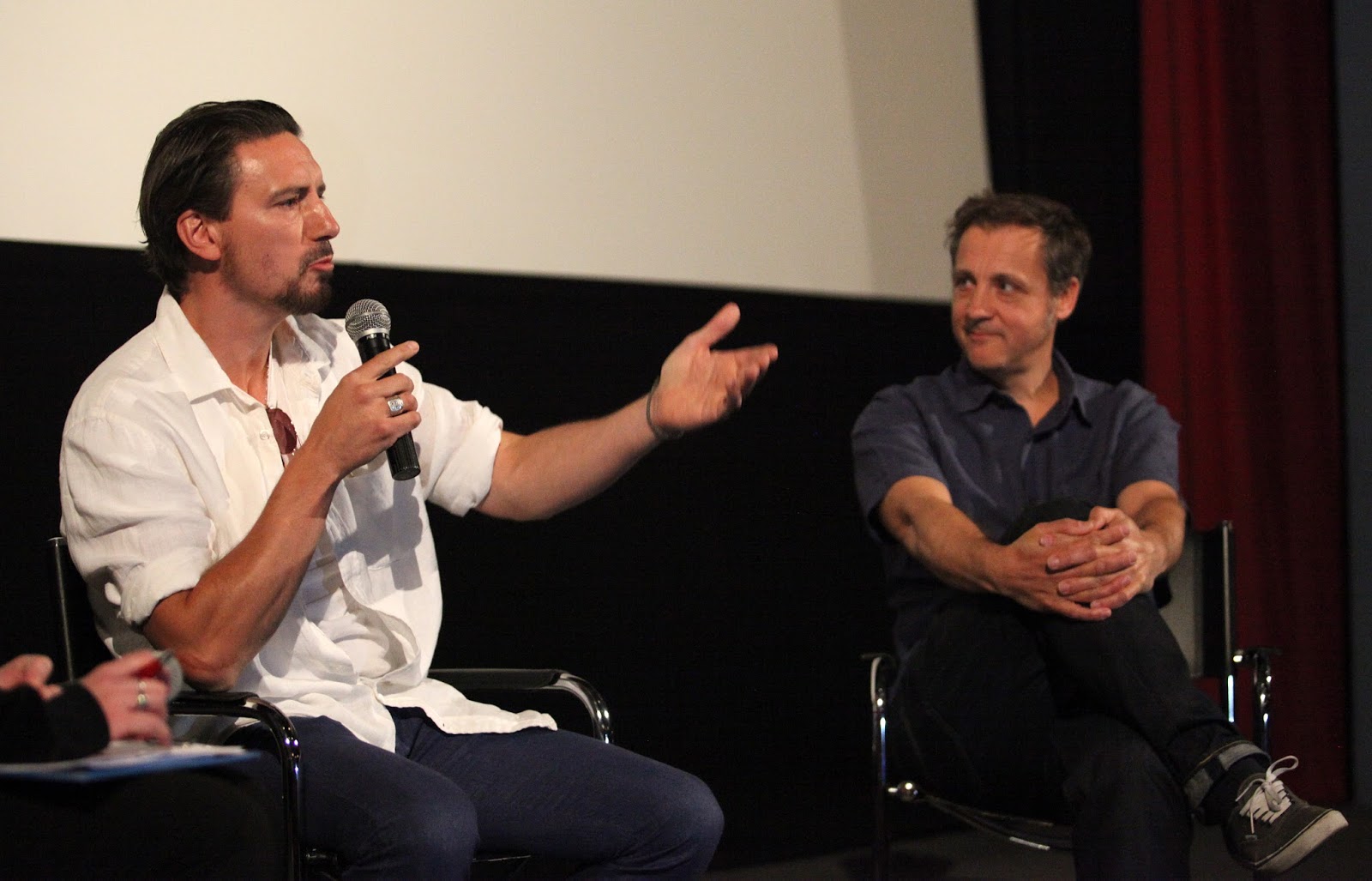
Actor Martin Askew (left) with director Andrew Hulme at Rio Cinema, Dalston. Photo: Mustafa Koker
NEWS/UK

Perceptions about Islam, the gentrification of inner London, and ‘how do you tell your gangster family that you’ve converted to Islam’ were among the questions put to film director Andrew Hulme and actor Martin Askew at a special screening of Snow in Paradise,  a film which they wrote together.

Inspired by Martin’s life and shot locally in Dalston and Shoreditch, the critically acclaimed film charts the life of a young Eastend gangster whose life hits rock bottom following the death of his best friend. It tackles guilt, fear and redemption, as well as the changes in urban London and attitudes towards Muslims and multiculturalism.  

Some 70 people attended the screening and Q&A at the Rio Cinema in Dalston on Saturday 6th June that was chaired by T-VINE editor İpek Özerim. The diverse audience encompassed a broad age-group, from students to the elderly, as well as multiple ethnicities. Among those asking questions were representatives of faith groups, including Faith Matters patron Filip Slipaczek, filmmakers such as award-winning film sound editor Nigel Holland, local councillors Emine Ibrahim and Peray Ahmet, local residents and curious others.
Photo: Mustafa Koker
Many of the questions were directed to Martin Askew, a “Cockney Muslim” by his own admission who happily chatted about his youth, conversion to Islam and the challenges making Snow in Paradise. Martin grew up in nearby Hoxton where the community was entrenched in a culture of crime. His uncle Johnny Wall was an East End legend and a boxing champion, and his cousin Lenny “The Guvnor” Mclean was the most famous bare knuckle street fighter in the country, who was given the title of Briton's Toughest Man and later starred in the film Lock Stock and Two Smoking Barrels.

Martin excelled as a young sportsman. However, his career was cut short suddenly one day as he was walking home with friends when two men tried to stab him. During the ensuing street fight one of his friends was murdered in front of him. On the way to the funeral, four of Martin’s best friends were then killed in a horrific car crash. These events changed Martin; his fear of being the next victim catapulted him into a street gang where hard drink, drugs and violence became the norm, although it couldn't ease the pain and the guilt he was hiding.

Photo: Mustafa Koker
The vicious circle continued, until what Martin describes as the ‘best night of my life’: the night six bouncers gave him the worst beating ever. He lay in the gutter smashed to pieces and fighting for his life.... That’s when he made his first prayer and during his recovery, he discovered Islam.

"I’m as English as any in the EDL & Islam is here to stay in the UK.”

Martin explained it had taken him 10 years to fully convert, that reading the Koran had touched him deeply and the Prophet Muhammed became his “superman.”

On how he broke the news to his family, Martin said, “As a budding actor, even wearing a trendy jacket got you labelled a ‘poof’”, so he initially kept his creative pursuits away from his macho community: “I had to hide being in the arts, let alone being a Muslim. It wasn’t easy being different back then.”

On how the media and other commentators bombard Western audiences with a singular, negative narrative around Islam, Martin said there are challenges on two fronts. He’s had to counter those Muslims who promote a radical view of jihad, as well as those who condemn the religion as ‘barbaric’ and unwelcome in Britain: “Islam isn’t the enemy. I’m as English as any in the EDL and Islam is here to stay in the UK.”

Photo: Mustafa Koker
His uncle and cousin, who had encouraged him to enter the arts, had passed away before the news about his conversion was properly known. After initially struggling with his identity, where Martin explained he was rejected by both Muslims and others in his immediate community, he came to realise that “being a Muslim is not about lineage, or ethnicities, and I have nothing to be ashamed of. At its core, [my faith] is about my connection with the Creator, finding my inner essence and being a good soul.”

Havva Murat-Başkal, the former deputy editor of Zaman UK, praised the film for “shining a positive light on Islam in the current climate”. This view was echoed by Haringey Councillor Emine Ibrahim who was also “pleased to see the gentrification issue tackled in the movie”, as it affects large parts of London including her own borough.

Photo: Mustafa Koker
Others asked Andrew Hulme about the funding challenges he faced in Britain and why the film, which had taken six years from inception to its UK release in February, wasn’t as well promoted in the UK as it has been on the continent, to which he replied:

“It was a film that had no UK funding and a very small budget and its major triumph was being picked as part of the Cannes Film Festival Official Selection in 2014. It got a standing ovation. So most of its interest has come from Europe, France and Germany in particular. In the UK it’s had a tough time. It’s hard to know why.”

One elderly Jewish lady highlighted the fact that the mosque used in the film (in Shackewell Lane, Dalston) was a synagogue before Turkish Cypriots bought it in the 1970s and converted it into a mosque. A young man from the local Orthodox Jewish community training to be a rabbi said his parents came from Jewish and Muslim backgrounds, but he had decided to follow Judaism. He congratulated Martin for “talking about the one God – which is the same God for Judaism, Christianity and Islam.

Photo: Mustafa Koker
Many young Muslims thanked Andrew Hulme for making the film and one British Somalian student told T-VINE afterwards: “We heard about this screening from our filmmaker friends in Spain. We are so glad we came. It’s a really good film and Martin is such a cool guy. He was so open about his life. We hardly ever hear positive news like this in the British media.”

The event was organised by T-VINE Magazine – the UK’s first & only English consumer publication for British Turks. The event was sponsored by inter-faith charity Faith Matters, anti-Muslim bigotry monitoring group Tell Mama, international food brand Aytaç and the multi-award-winning Best Turkish Kebab in Stoke Newington.


L-R: Andrew Hulme, Recep Ercan, MD of event sponsor Aytaç Foods, Martin Aksew. Photo: Mustafa Koker


See all the photos from the screening and Q&A event here courtesy of Mustafa Koker.


RELATED ARTICLES

Snow in Paradise – inspired by a true story about a British gangster turned Sufi Muslim, 24 May 2015

Snow in Paradise – Evrim Ersoy film review, 13 Feb. 2015


Sunday, 14 June 2015

Turkish brands meet UK counterparts at ‘quality in business’ conference in London

Fahri Ustaoğlu with Semra Eren-Nijhar, recognised for her research into Turkish migrants in Europe
NEWS/UK

Owners of small and medium-sized businesses from diverse industry sectors in Turkey were in the capital on Thursday to explore business opportunities as part of a unique networking event organised by Leaders of Branding Intelligence (LOB’IN) and the European Turkish Association (ETA). Titled 8th International European Quality Conference, the business summit took place at the London South Bank University (LSBU).

Among the Turkish companies attending were airline Atlasglobal, leading coffeehouse Gönül Kahvesi, TGRT TV – selected Turkey’s Best News Channel of the Year in 2015, Altınçatı Elderly Care Homes, healthcare experts ILO Autism, and telecommunications and wireless solutions specialist Net İletişim. They met with entrepreneurs based in Britain whose ethnic origins and business interests spanned Africa, Europe, and South Asia.

Keynote speakers included Sunil Chopra, the past Mayor of the London Borough of Southwark, whose term in office was marked by activities aimed at bringing diverse communities together. The event kicked off with a welcoming speech from Prof. David Phoenix, the Vice-Chancellor of LSBU, who explained that the university was not only home to 20,000 students from 120 countries, but also assisted SMEs through the university’s unique range of consultancy services.

Some 80 people attended in total, including university heads of departments, a former UK government advisor and the head of Turkey’s UK Tourism Office. Along with exchanging ideas and exploring business opportunities, awards were also presented by Fahri Ustaoğlu, President of LOB’IN, to those companies and individuals who have demonstrated outstanding quality in their work.

T-VINE columnist Semra Eren-Nijhar was among those recognised. The sociologist and documentary-maker has extensively documented Turkish migrants and their contributions in Europe. In December 2014, she launched the UK’s first-ever Turkish Heritage Day, backed by the Mayor of London Boris Johnson.

Turkish singer Ekin (2nd left) with Creative Africa team & other delegates at conference
Working with local partners, LOB’IN helps to build important business bridges for Turkish companies by organising a range of events around the world, including in Istanbul, New York, Frankfurt and Brussels. Their next event is set to take place in San Francisco. Their LSBU event was organised in conjunction with ETA.

ETA chair Mustafa Aydın told T-VINE: “While the event was smaller than usual LOB'IN events, the calibre of participants was fantastic, as was their feedback. Everyone commented on the warm and inclusive atmosphere, and the excellent opportunities that have arisen from networking. Even our entertainer Ekin [renowned Turkish folk singer] fitted the bill perfectly: his duet with Caribbean artists [Soca Boys] and experiences growing up in Denmark hit a chord with our diverse audience.”


Saturday, 13 June 2015

Hackney Downs set to host 5th Alevi Festival this Sunday

Özlem Taner will perform traditional and contemporary Anatolian Blues
CULTURE / FESTIVAL

This Sunday the UK’s Alevi community will again bring its unique sights and sounds to Hackney as part of its annual cultural celebration. Masters of Anatolian Folk music will provide a rich tapestry of sounds that are inspired by Alevi spirituality and culture. There’s also folk dancing, children’s activities and a delicious selection of Turkish street food.

Headlining this year’s festival is Ezginin Günlüğü – an indie Turkish folk band whose contemporary rhythms are steeped in Anatolian’s traditional music. First formed in Istanbul in 1982, the band dissolved in 1990 before being reformed with new members, which hit the Turkish mainstream with their 1995 release Oyun (Game).

Other visiting artists from Turkey are Anatolian rocker Oğuz Boran, and producer, composer and singer Seyfi Yerlikaya, whose name has become synonymous with Türk Halk (Turkish Folk) and Özgün (protest) music.

Also on Sunday’s line-up is Gaziantep’s Özlem Taner, a singer and musician of Turkmen origin who is best known for her contemporary renditions of Türkü (Turkish Blues) music. Part of the internationally-respected Kalan roster of artists, her 2007 release Türkmen Kızı (Turkmen Girl) made international waves for its beautiful harmonic bridge between not only traditional and contemporary Anatolian Folk music, but also Turkey’s diverse ethnic and spiritual communities.

The festival is organised by the UK Alevi Federation, which represents twelve Alevi cultural centres and cemevis (religious buildings) across Britain: in London, Glasgow, Coventry, South London, Croydon, Harrow, Bournemouth, Nottingham, Doncaster, Hull, Sheffield and Edinburgh.

It is estimated that one in five people from Turkey are Alevis – the country’s second biggest faith group. This mystical branch of Islam includes beliefs and rituals that pre-date the religion. Unlike other Muslims, men and women worship together in the cemevi, and music and dance play a central role in their faith.


Festival date: Sunday 14 June 2015
Starts: midday
Address:  Hackney Downs Park, Downs Park Road, London E5 8NP
Entrance: £2 (adults)
More Info: UK Alevi Federation


Friday, 12 June 2015

EXCLUSIVE: How Ted & Mus conquered Turkish barbering

FEATURES

By İpek Özerim

We may be living through the austerity years, but one sector that is booming is men’s grooming. Men’s desire to splash the cash to look good has propelled the sector to be worth some £1 bn.

It’s not just about buying moisturiser and bronzers. Guys are also bypassing the cheap and cheerful barbers’ shop where you enter with a unique barnet, but exit with the uniform one-style-suits-all clipper-cut ‘short back and sides’ for more expensive trims. 

At the heart of this explosion in quality men’s hairdressing are Turkish barbers. They’ve sprung up in every town across the UK. Among the best known is Ted’s Grooming Room, part of the top British fashion retail brand Ted Baker. 

T-VINE went on a mission to find out how an Englishman has come to be driving the coolness and popularity surrounding Turkish barbering. We meet Mus Ismail, a Turkish Cypriot barber and co-founder of Ted’s Grooming Room

He started off in his father’s shop in Holborn. After taking control, he transformed the business, gaining a reputation as one of the most prestigious barbershops in the capital. They developed a celebrity following and then one day Ted Baker’s owner Ray Kelvin started coming in. Mus takes up the story:

“Once we became established as the best in central London, a few celebrities started coming in, and eventually they brought their friends, until you couldn’t walk into the Grooming Room without seeing a famous face being shaved. Showbiz is a small world, and once you cut one person’s hair, it isn’t long before the rest follow.”

“Naturally, a lot of these guys came from the fashion scene. We had a few well-known names but the one who loved us the most was Ray. He loved everything about the shop: the service, the fit-out and the quality of cuts and shaves. He really appreciated the quality and attention to detail of our work. The most important thing was the energy and atmosphere on the shop floor. I’ve always employed the best young barbers around and this created an unbelievable buzz in Holborn.”

“After coming in for a few years, he asked if I would like to team up with his brand, and it seemed like a perfect fit.” 

“Ted Baker loved everything about the shop: the service, the fit-out and the quality of cuts and shaves.”

So an Englishman falls for the charm of Turkish barbering and invests. And with nine branches opened in the past five years, the formula is clearly working. We ask Mus what he credits this phenomenal success to.


“The most important decision I made was not to be afraid of taking a chance on young talent. We have the biggest team of top quality barbers in Britain and we insist on a consistently high standard of service in every one of our venues. We serve ten to fifteen thousand customers per month and plan to open more Grooming Rooms soon, so this is hugely important. Not only does this mean we have guys who are extremely loyal to Ted’s Grooming Room (TGR) but that we have the most energetic atmosphere of any barbershop in London.”

“The guys I employ are all highly talented, but we’ve taught them how to combine this with professionalism. And when you’ve got a whole team of young barbers who are not only well-trained, but have also been taught how to look after a Central London customer, you’ve taken the game to a whole other level.”

“When you consider the fact that our barbers work fewer hours than in other Turkish places, it means they can maintain their highest standards for every single client. And they have time to socialise with each other after work. Look after your staff and the business will look after itself; that’s why we arrange for our guys to use our cocktail bars and go on socials with each other. A happy barber makes for a happy customer.”

“We’ve shown the barbering world how to improve the overall experience of visiting a barbers’ shop. There isn’t another barbers’ shop in London – Turkish, English or otherwise – that can offer the experience we have. Several magazines have named us as one of the best barbers’ shops in the world. Our barbers are so respected, Wahl have told me personally that they won’t let our guys enter their contests because it’s unfair on the competition!”

“It’s not just the consistency and excellence of our barbers that sets us apart though…Ted’s Grooming Room is an entirely different brand to any other barbers; you simply can’t compare it to anywhere else. I’ve yet to find anywhere that has a high-quality sound system and a cocktail service in their store – three of our shops have a bar run by the Looking Glass Cocktail Club. We love to collaborate with brands like this; we’re the best in our field and we want to work with people who are the best in theirs.”
 
Cocktails while you wait, Sir? All part of the TGR service
He admits success was never guaranteed, but having found the optimum mix of barbering services, Mus remains committed to bringing through the next generation of top Turkish barbers and becoming internationally renowned as the best barbering establishment in the world.

“We have plans for four more Grooming Rooms in the pipeline. And while we are constantly receiving requests from around the globe, we are one hundred per cent determined to stay in London; I’m a Londoner who built a brand in my city and I want it to stay here.”

“I wasn’t an overnight sensation; I’ve fought my way up from a very early age. People always ask why we employ so many young Turkish barbers, and it’s because I came from that community. We’re constantly on the lookout for young blood; ambitious people who can keep challenging me and moving the business forward. No matter how successful Ted’s Grooming Room may have become, I’m still a barber at heart and I can always spot the good ones.” 

In keeping with its local heritage, one of the displays at TGR's medically-themed Mortimer Street branch

RELATED ARTICLES

Eray & Koray pay Ted’s Grooming Room a visit, 12 Jun 2015

Eray & Koray pay Ted’s Grooming Room a visit

Koray's facial hair gets the full treatment at
Ted's Grooming Room, Mortimer Street, W1
STUFF / HIS 

After leading the way in fashion for many years now, Ted Baker recently diversified into old school Turkish barbers with Ted’s Grooming Room. We heard on the T-VINE they’d opened the doors to their newest site in Mortimer Street (complete with medical theme, as pictured below). To celebrate the launch, we took our Turkish selves down there to check it out.

Situated over two floors, they offer haircuts, beard trims and of course the traditional Turkish shave. 

Downstairs you'll find a cocktail bar built-in, offering you the chance to sip some fine concoctions while you’re being groomed. 

The shaves are done in a traditional fashion with hot towels, cut throat razors and a standard splash of Kolonya after every shave.

Even if you don’t need a makeover, the experience alone is worth the visit: treat yourself to a shave, a drink and, if you’re lucky, a bit of lokum (but you didn’t hear that from us).


RELATED ARTICLES


How Ted & Mus conquered Turkish barbering, 12 June 2015


Monday, 8 June 2015

HDP passes 10% election threshold as AKP loses its parliamentary majority

NEWS/TURKEY

Turkey’s ruling AK Party has lost its single party majority, while the Kurdish-focussed HDP secures its first seats as a national party in the Turkish Parliament having broken through the 10% election barrier.

Turnout for yesterday’s General Election was 86.63% from a possible electorate of 53.7 million, including over one million first-time voters who have turned 18 since the last elections. With 99.99% of all ballot boxes counted, the polling results for the four main parties are as follows:

AKP % 40.86 – 258 MPs
CHP % 24.96 – 132 MPs
MHP % 16.29 – 80 MPs
HDP % 13.12 – 80 MPs

It means AKP is 18 seats short of an overall majority, spelling the end of its 13-year single-party rule. The election results also check the plans of former AKP leader, President Recep Tayyip Erdoğan to change the governance of Turkey into a Presidential system.

As HDP and other opposition party supporters celebrated, AKP government officials and supporters appeared glum as the news emerged that they had lost huge electoral support and seats in Parliament.

 
Turnout was 86.63% for Turkey's General Election. Photo: Milliyet

Winners and losers

While the political map of Turkey remains the yellow of AKP, which came first in most districts across the country, its popular vote has slipped by nearly 10%. That and a fourth party – HDP – entering Parliament have seen the number of AKP MPs tumble.

Since coming into power in 2002, AKP has seen its share of vote increase at each General Election. In 2011 the party, then headed by Erdoğan, secured 49.8% of the vote and won 327 seats. The party had seemed unstoppable, further cementing its place as Turkey’s governing party when Erdoğan took the presidential elections in the first round in 2014 with 52% of the vote. All this is set to change following the 2015 elections.

The main opposition party CHP did not perform as well as it had expected. Its support and number of MPs marginally decreased from its 2011 polling (down 3 seats and 1% votes) with some CHP voters backing HDP instead to ensure the smaller party would make it into Parliament. MHP enjoyed a 3% increase in its popular vote and its MPs leapt from 53 to 80.

In previous elections, Kurdish-focussed politicians had stood as independents to overcome the exceptionally high 10% national vote threshold. The 30 candidates who entered the last Parliament as independents then came together under a common political umbrella.

Selahattin Demirtaş at election rally on 24th May. Photo: NRT TV
Buoyed by the strong polling of HDP co-leader Selahattin Demirtaş in last year’s presidential elections, where he received just under 10% of the vote, the party decided to stand nationwide. The gamble paid off as it now enters Parliament with 13% of the vote and 80 MPs.

MPs close to the Fetullah Gülen Movement (also known as Cemaat) saw its support base collapse in 2015. Former AKP MP Hakan Şükür and his fellow Cemaat colleagues Ali Fuat Yılmazer, Yakup Saygılı and Yurt Atayün all polled 1% or less, meaning they have no voice in the new Parliament.


Women and minority representation goes up

Turkey's 25th parliamentary election sees a rise in the number of women deputies elected, increasing from 79 in 2011 to 96 in 2015. HDP had made a big point of ensuring there was a nearly 50:50% gender split among its candidates, which has helped increase the overall numbers.

The most number of female deputies are in AKP with 41, followed by HDP with 31 female MPs, then CHP on 20, and finally MHP with a mere four out of its 80 MPs.

Another breakthrough in the 7th June elections is that Turkey’s Christian population will be represented by four deputies in the new Parliament. Three Armenian Turks have been voted in as MPs for Istanbul: Markar Esayan, a journalist for the pro-AKP daily Yeni Şafak, becomes an AKP deputy, lawyer Selina Doğan was elected for CHP, along with HDP’s Garo Paylan – a trainer on the Supreme Election Board. Lawyer Erol Dora, who is a member of Turkey’s Syriac community, is one of three HDP MPs elected in Mardin.
 
Selina Doğan, a Christian and of Armenian heritage, becomes a CHP deputy
Özcan Purçu becomes the first openly Roma candidate to enter Parliament. He won for CHP in Izmir province.

HDP’s two Yazidi heritage candidates, Felaknas Uca and Ali Atalan, are also elected as MPs. 


Major policy issues

Among the major policy battles in these elections were the economy. The opposition parties homed in on Turkey’s worsening economic climate, while the ruling party pointed to its successful track record since coming into office in 2002. All the main parties struck a mature note in the debate, stepping away from populism to promise key reforms and measures to put the Turkish economy back on a strong footing.

Other key issues in party manifestos included freedom of speech in Turkey, foreign policy (from the Cyprus Issue to EU entry, and the Syrian conflict), addressing the decades-old Kurdish Problem, reforming the judiciary and higher education systems, and changes to the governance of Turkey, with AKP backing a shift to a presidential system.

It follows President Erdoğan’s naked ambition to boost his powers following his election to the country’s top post last year. He has already broken with constitutional rules by chairing cabinet meetings and openly supporting AKP in the General Elections, while constantly slamming the opposition parties at public rallies. His non-partisan role and strident comments, along with numerous luxury purchases including a new opulent 1,150-room Presidential palace that cost Turkish taxpayers $615 million, has jarred with many voters.
 
President Erdoğan poses in AK Saray, his new 1,150-room palace that cost taxpayers $615 million. Photo: AFP/Getty
The scandals that have dogged AKP in recent years have also come to the fore during the elections. The failure of the government to try those implicated by major corruption allegations, including Erdoğan’s son and four Government Ministers, led to the party being dubbed “Thieving AKP” during the election campaign.

AKP received a further shock when leading Turkish daily Cumhuriyet published new evidence that seems to counter government claims that its intelligence agency sent aid to Turkmens: Cumhuriyet’s evidence shows arms in MIT-operated trucks being driven to Syrian Islamist opposition fighters. With the second anniversary of the Gezi Uprising falling during the election campaign, the government’s anti-democratic crackdowns were sharply back in focus too, particularly among Turkey’s first-time youth voters.


Overseas Turkish voters back AKP and HDP

Since 2012, Turkish citizens living abroad have also had the opportunity to vote in Turkey’s elections. This year, one in three of a possible 3 million people exercised this right, casting their vote at one of the 112 polling booths opened around the world and at Turkey’s customs points.

AKP fared well with ex-pat voters taking just under 50% of all votes cast, while HDP also polled strongly with 21%. CHP and MHP won 16.95% and 9.14% respectively.

AKP came first in territories such as France, Germany, Australia, North Cyprus, Norway, Algeria, Iran, Saudi Arabia and several central Asian countries including Ozbekistan. HDP topped the polls in the UK, Canada, Sweden, Finland, Ukraine, Poland, Italy and Japan. While its share of vote was lower than HDP, CHP won in multiple states including the USA, Eire, Spain, South Africa, Russia, China, and the Czech Republic.

Long queues formed outside Olympia, London as overseas voters cast their vote in the Turkish General Elections


Violence mars run-up to General Election

Tensions were high throughout the election campaign, with multiple violent clashes – some deadly – between opposing supporters.

HDP claims its members have suffered over 140 attacks in the run-up to the 2015 General Election, including two bomb blasts at its final rally in Diyarbakır on Friday, which killed two and wounded at least 200. Two days earlier, a 35-year-old driver of one of HDP’s campaign vehicles was shot dead in Bingol, in eastern Turkey, his bus raked with bullets.

Last month, two of HDP’s political bureaus in Adana and Mersin were also targeted by bombers, one exploding just moments before Selahattin Demirtaş was due to arrive for a pre-rally meeting.
Outside HDP’s political bureau in Adana, which was destroyed following a bomb blast in May
In May, AKP candidate Ramazan Demir was stabbed in the stomach while campaigning in the Aladağ district, in Adana. In February, Fırat Yılmaz Çakıroğlu, a youth leader for MHP, was stabbed to death by Kurdish militants during a fight on the Ege University campus.

Security was stepped up for Election Day with 300,000 police officers on duty supported by some 100,000 gendarmerie. 


Responses to the 2015 election results

The BBC’s Mark Lowen said: “In a volatile Middle East, Turkey matters greatly - and so the path it takes, the nature of its democracy and the leaders it produces, all have implications far beyond its borders.”

Trying to put on a brave face, Turkish PM Ahmet Davutoğlu told his supporters that “Everyone should know that the AKP is the winner of this election…[that this party is] the backbone of Turkey."
 
PM Ahmet Davutoğlu tries to put on a brave face after his party loses parliamentary majority
HDP deputy and actor Sirri Sureyya Onder countered by saying: "This was a victory of democracy over political corruption... of peace over war."

His party co-leader Demirtaş told a news conference in Istanbul that, "The discussion of executive presidency and dictatorship have come to an end in Turkey with these elections."

With no outright winner, talk has turned to which parties will form a coalition government and whether an early general election will be needed to try and shift the power balance.

The election results have also prompted jitters on the stock exchange. The Turkish lira traded near a record lows on June 8 as nervous investors reacted to the prospects of a minority or coalition government.

Tuesday, 2 June 2015

Get away to the Çanakkale Peninsula

Çanakkale Martyrs Memorial, Hisarlık Hill, Morto Bay
PLACES / HOLIDAYS

Visiting the Gallipoli battlefields during this centenary year is certainly one the major reasons to travel to the southwest coast of Turkey, but that’s not all the Çanakkale district has to offer. From its charming old city centre to the resplendent ruins of ancient Troy, travellers can sample the best of classic and contemporary history, while also enjoying a dip in the Aegean Sea.


Touring the battlefields

Situated between the Dardanelles and the Aegean Sea, the natural beauty and tranquil nature of today’s Gallipoli Peninsula makes it difficult to imagine the calamitous war that occurred here one hundred years ago. The area is now protected as a national park and has become a place of pilgrimage for Turks and foreigners alike who come to pay homage to the bravery and camaraderie of the soldiers who fought and died here.

There are multiple cemeteries and memorials for both Turkish and Allied soldiers. The easiest way to see them all is by car. The roads are well-maintained and signposted. Those happier on foot, but short on time can do the ‘Anzac Walk’ – a one-day trek that starts at North Beach and snakes through the various battle sites on the Peninsula. It includes a visit to Anzac Cove, where the Allies first landed on 25 April 1915 and which formed the military base for Australian and New Zealand troops during the eight-month campaign.

In nearby Arı Burnu, you can find the monolith that is inscribed with the famous words by Mustafa Kemal Atatürk to the first Australians, New Zealanders and British to visit the Gallipoli battlefields in 1934. The site and North Beach now form part of the annual Dawn Service that takes place every 25th April.

The Çanakkale Martyrs Memorial (main picture) is located on Hisarlık Hill in Morto Bay at the southern end of the Peninsula. Measuring 41.7 m (137 ft) high, this huge monument, in the form of four square columns with a thick concrete crown, is visible from the Dardanelles. Underneath the memorial is the War Museum, which includes displays of original personal and military items, such as cutlery, a set of false teeth, belt buckles, sniper shields, and photographs found on the battlefield.

Other notable monuments include the Cape Helles Memorial to the Missing, a towering stone obelisk whose square base walls bear the names of the 20,673 British and Commonwealth servicemen who lost their lives nearby but for whom no grave exists. The 57th Infantry Regiment Memorial, which was unveiled in 1992, is dedicated to the Turkish troops who died defending the cove when the Allies landed in April 1915. Every man in the regiment was killed fulfilling the command of Lieutenant-Colonel Mustafa Kemal, who said: “I do not order you to attack, I order you to die. In the time which passes until we die other troops and commanders can take our place."

A modern addition for military historians is the Gallipoli Simulation Centre (Çanakkale Destanı Tanıtım Merkezi), just east of the village of Kabatepe and a short drive along the coastal road from Anzac Cove. Here, visitors can embark on a 2-hour long, 3D-journey through the Gallipoli naval and land campaigns that are displayed in 11 hi-tech galleries, which alternate between the Turkish and Allied experiences.


Troy – where mythology meets archaeology

This giant wooden horse, used in the 2004 film 'Troy', now stands in Çanakkale city centre
Written about by Homer in his epic poem Iliad and the focus of many a Hollywood film, Troy (Truva in Turkish) is a land of ancient wars and legends, making it a must-see destination for any visitor to the region.

A 40-minute drive from Çanakkale, Troy is situated on the Biga Peninsula, on the slopes of Kaz Dağı (also known as Mount Ida), close to Edremit. Since being founded in 3000 BC, it has survived numerous attacks by local and foreign powers keen to capture this strategic town that overlooks the vital Dardenelles Straits, which divide Europe from Asia. Today it is a protected World Heritage site due to the extensive archaeological excavations, including Troy’s ancient city walls, the ancient town of Assos where Aristotle once lived, and a holy site in Gülpınar where stand the impressive ruins of Apollo Smintheus Temple, which is also referred to in the Iliad.

A myriad mythical stories revolve around Troy. The most famous concerns the world’s first beauty contest: at a party thrown by Zeus, three goddesses – Hera, Athena and Aphrodite – seek to claim a golden apple from the Garden of Hesperides inscribed with the words ‘for the fairest one’. Unwilling to make a choice between the three, Zeus asks Paris, son of Trojan King Priam, to decide instead. Paris chooses Aphrodite, who rewards him with the most beautiful woman in the world, Helen, the wife of the Greek Spartan king Menelaus, whom he promptly abducts.
 
Ruins at Assos
The wrath of the Greeks triggered a 10-year war with Troy. They finally broke through with a cunning plan that involved the construction of a giant wooden horse in which they hid a crack squad. The Greeks pretended to give up the fight by sailing away, abandoning their horse, which the Trojans brought into their city as a victory trophy. That night the Greek army sailed back under cover of darkness and entered the city after their soldiers had crept out of the horse and opened the city gates. Troy, said to be one of the most advanced cities of its age, was totally destroyed.

Written in his hometown of Izmir, Homer’s dramatic words not only immortalised the memory of the Trojan War, believed to have taken place around 1200 BC, but also inspired Hollywood. Two of its best known films are Helen of Troy (1956), and Troy (2004), the latter starring Brad Pitt and Eric Bana. You can see the giant wooden horse from the 2004 film in Çanakkale city centre.


Çanakkale City

Photo: TourMakerTurkey.com
Once famed for its ceramic products under the Ottomans, Çanakkale now operates as a marina for tourists and a small, but busy port for trade. It is home to some 200,000 inhabitants including students at the local university. The old town maintains its charm with its narrow, cobbled streets and Ottoman-era town houses. Its waterside promenade and nearby wharf remain lively all year round with numerous cultural events.

City landmarks include the five-storey Ottoman Clock Tower (pictured), paid for by an Italian merchant in his will, the local Kent Museum charting the history of Çanakkale since Ottoman times, and the Korfmann Library, housed in a 19th-century former school in the old town opposite the Tifli Mosque. It was the bequest of the late Manfred Osman Korfmann (1945–2005), a former archaeological director at Troy, and contains 6,000 volumes on history, culture, art and archaeology.


Beaches

It may not be in Turkey’s top 10 beach holiday destinations, but the Peninsula does offer plenty of tranquil coves that are ideal for those after some sea and sun. It pays to get away from the city centre, where the sea is often polluted. A 60 km drive from the city brings you to Bozcaada – a small island off the mainland that is accessible by car ferry. Its Habbele Beach boasts clear blue water, and the islanders are renowned for their fishing and the production of good local wines.

Or embark on a boat from the city centre and glide across the Dardanelles to Zargana Beach, located in the foothills of Kilitbahir (meaning ‘lock of the sea’) Fortress. The local village provides all the amenities you would need for a short stay. Further up on the same stretch of coast is Kabatepe Kumsalı, which has a lovely campsite in a forest – the perfect shaded backdrop for sunny days on the adjoining sandy beach with its crisp blue sea. Best avoided during the peak season of July and August.


Getting there

With Pegasus AirlinesLondon to Balikesir/Edremit airport, then a 1.5 hours drive to Çanakkale, £119 one way. 

Travel from Istanbul by coach (6 hrs), or fly to Çanakkale airport, or take a ferry boat from Yenikapı to Bandırma, and complete the journey by bus (just over 4 hrs).